Bonds International Casino: The Real Story Behind the Times Square Venue
Few venue names in New York City history have caused as much confusion as Bonds International Casino. Strip away the name and what remains is a layered story: a 1930s Art Deco dinner club, a mid-century retail landmark, and a 1980s nightclub that briefly placed Times Square at the center of the American live music scene. Bonds International Casino is closely associated with the historic Bond International Casino and Bond’s Casino names used for the same Broadway location.
The word casino in the name referred to an entertainment setting rather than a licensed gaming operation. No slot machines, no roulette wheel, no poker room. What the venue offered instead was a stage, a dance floor, and one of the most memorable concert residencies in New York rock history.
What Was Bonds International Casino?
Bonds International Casino was a nightclub and concert venue on Broadway between West 44th and West 45th Streets in New York City. Its name combined two distinct pieces of the building’s past: the International Casino, a large pre-war dining and cabaret space that opened on the same Times Square site in 1937, and Bond Clothes, the men’s clothing retailer that dominated the address for decades afterward.
When the space reopened in 1980 as a live music and nightclub venue, that combined name came with it. Reliable venue histories do not identify the location as a licensed gambling establishment at any point in its operation.
The International Casino: A 1930s Dinner Club
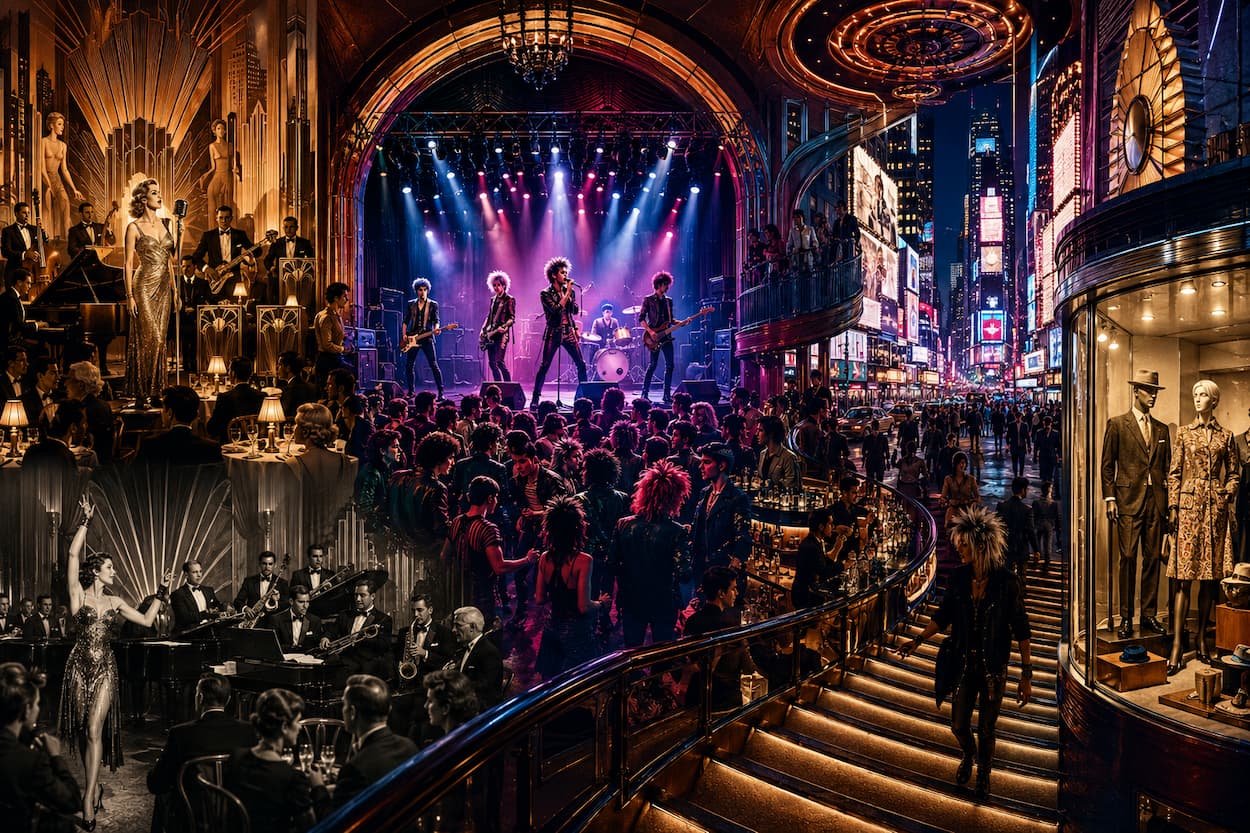
The foundation of the Bonds International Casino story lies in the original International Casino, which opened in 1937 as one of Times Square’s grandest nightlife destinations. This was a dinner club in the fullest sense: food, drinks, live orchestras, a generous dance floor, and elaborate revue shows staged for large audiences.
The design reflected the Art Deco spirit of the era, with dramatic lighting, sweeping dining rooms, and a stage built for theatrical spectacle. The International Casino belonged to a New York nightlife tradition that prioritized performance and atmosphere above all else. It closed by around 1940, ending its run before the war years reshaped the city.
Bond Clothes and the Building’s Retail Era
After the International Casino closed, Bond Clothes took over the Times Square site and turned it into one of the street’s most recognizable commercial presences. The store’s illuminated signage became a visual fixture of mid-century Broadway, and the Bond name remained attached to the address for decades.
Bond Clothes operated at the site until 1977. Its long retail tenure is the reason the Bond name carried forward into the 1980 nightclub reopening. When the venue launched as Bond International Casino, the title fused both layers of the address’s identity: the pre-war dinner-club heritage and the more recent retail landmark. That layering of names would prove confusing to later audiences, but it was entirely logical to anyone familiar with the building’s history.
The 1980 Nightclub Opening
Bonds International Casino opened as a nightclub in 1980, entering New York’s entertainment scene at a moment when disco was fading and rock, punk, and hip-hop were competing for the same stages. The venue’s reported capacity of around 1,800 made it one of the larger club-format spaces in the city.
The interior was configured for live performance: a prominent stage, a wide dance floor, theatrical lighting, bars, and a dramatic stairway that gave the space visual scale. It was built to hold a crowd and amplify energy, not to seat guests quietly at gaming tables.
Programming moved across genres. Bonds International Casino hosted disco nights and DJ sets alongside rock concerts, placing it at a crossroads in New York’s shifting nightclub culture of the early 1980s.
Was Bonds International Casino a Gambling Venue?
Despite its name, Bonds International Casino was not a gambling establishment. The venue is not documented in reliable historical sources as operating a casino gaming floor. There is no historical record of slot machines, roulette, blackjack, poker rooms, baccarat, craps, or licensed wagering of any kind at this address.
The word casino in the name reflected the site’s pre-war entertainment heritage, not a gaming license. The original International Casino was a dinner club. The later Bond’s Casino was a nightclub. Neither operated as a gambling hall, and the venue had no hotel, resort, or casino-hotel services attached to it.
The Clash at Bonds International Casino
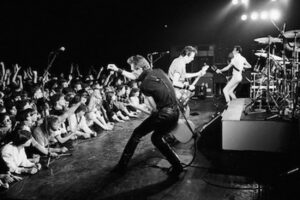
The Clash’s 1981 residency is the single most documented and most widely remembered chapter in the venue’s history. In May and June of that year, The Clash played a 17-show run at Bond’s Casino in Times Square while supporting their Sandinista! album, a figure confirmed by the band’s official history.
The series began as a shorter engagement and expanded after ticketing disputes and capacity complications arose. By the time the final show played, the residency had taken on a significance beyond its original scope. The Clash were moving toward broader American recognition, and the club-sized intimacy of Bonds International Casino gave the shows a different character from an arena tour.
Opening acts during the run brought punk, reggae, and early hip-hop into the same rooms, making the residency a convergence point for several strands of New York music culture. Grandmaster Flash performed as an opening act during the run, a detail that has since become one of the residency’s most cited cultural footnotes.
For music historians and concertgoers who were there, Bonds International Casino is inseparable from those weeks. The 1981 shows remain the venue’s defining moment and the reason its name still circulates in discussions of American live music history.
The residency also carries significance beyond The Clash themselves. The decision to expand the run rather than cancel it, and the presence of hip-hop acts on a rock bill in Times Square, reflected a cultural moment when genre boundaries in New York were genuinely porous. Bond’s Casino happened to be the room where several of those boundaries dissolved at once.
Other Performers and the Venue’s Place in 1980s New York
The Clash residency was the high-water mark, but Bonds International Casino hosted a notably broad range of acts across its years of operation. Blondie, Grace Jones, Blue Öyster Cult, The Plasmatics, the Dead Kennedys, the Ramones, Bad Brains, Laurie Anderson, and Fab 5 Freddy all appeared at the venue.
That combination, spanning punk, new wave, disco, experimental art performance, and early hip-hop, placed the venue at an unusual intersection. Few spaces of its size and era programmed so broadly. The Times Square location, once associated with pre-war glamour and mid-century retail, briefly became a stage for some of the most forward-looking music of the decade.
Comparable New York venues of the period include Studio 54 for celebrity-driven disco, CBGB for punk and underground rock, Danceteria for downtown new wave, and the Paradise Garage for DJ and dance culture. Bonds International Casino sat between these worlds, large enough for arena acts and open enough in its programming to reflect the genre collisions of early 1980s New York.
What distinguished the Times Square venue from most of its contemporaries was scale combined with eclecticism. A capacity of 1,800 placed it well above the basement clubs that defined punk, yet its booking choices in the early 1980s aligned it more closely with the underground than with the mainstream. That combination did not survive the decade, but it produced a brief and distinctive chapter in New York nightlife.
Times Square Then and Now
Bonds International Casino operated during a specific chapter of Times Square’s history. The early 1980s district was commercially dense and entertainment-driven, before the large-scale redevelopment of the 1990s and 2000s transformed the area into its current form.
The site’s history traced a longer arc than the nightclub itself. The same block had housed an Art Deco dining spectacle in the late 1930s, a dominant retail chain for three decades after that, and then a rock venue that hosted The Clash. Each phase reflected a different version of what Times Square was and what it was becoming. The nightclub era represented the most musically significant chapter, even if it was also the briefest.
The venue’s run ended relatively quickly. In 1988, the space was remodeled and reopened as the Criterion Center, a pair of live theater venues. Around 2001, the site became a Toys “R” Us location, a use that itself ended with further commercial redevelopment in 2016, when Gap and Old Navy took over the building. Although the address remains part of Times Square’s commercial fabric, the original interior and exterior identity connected with Bonds International Casino no longer survives.
The Legacy of Bonds International Casino
Bonds International Casino is not an active venue. It is not a hotel, a current gambling establishment, or an online casino brand. Its identity belongs entirely to a specific period in New York’s cultural history: a short window in the early 1980s when a Times Square nightclub briefly stood at the intersection of disco’s decline, punk’s peak, and hip-hop’s emergence.
What survives is the record. Concert photographs, set lists, press coverage, and the memories of those who attended the 1981 shows keep the venue’s name in circulation. The name Bonds International Casino carries weight today not because of gambling, but because of a 17-night concert run that turned a Times Square nightclub into a lasting footnote in rock history. For a venue that operated as a concert hall for only a few years, that kind of durability is remarkable.
Latest News