

Stake Gamble Responsibly: A Complete Guide To Limits, Safety Tools, And Support Options On Stake
Responsible gambling on Stake is not simply a disclaimer placed at the bottom of a page. It is a practical framework of tools, policies, and support options designed to give users more control over how they gamble. The purpose is not to present gambling as a way to make money, but to keep it within the boundaries of entertainment and reduce the risk of harm. Stake’s own guidance makes the same point clearly: gambling should be approached as leisure, not as income, and chasing losses should never become the reason to keep playing.
This guide brings the most important parts of Stake’s responsible gambling framework into one clear structure. It explains where to find the main tools, what Deposit Limits, Wager Limits, and Loss Limits actually do, how Break In Play and Self Exclusion differ, when Self Assessment may help, what support pathways exist, and how external blocking tools and verification measures fit into the wider safety picture. The goal is guidance, not promotion.
What Stake Gamble Responsibly Means
The phrase “Stake gamble responsibly” should be understood as more than a brand slogan. It points to a system that combines user education, financial controls, temporary restrictions, long-term exclusion options, self-review tools, and links to outside support. The idea is simple: gambling stays safer when boundaries are set early and reviewed honestly.
Why Gambling Should Stay Entertainment First
The most important principle behind Responsible Gambling is that gambling should remain entertainment. That single idea shapes almost every other safety tool on the platform. When a person treats gambling as leisure, they are more likely to decide on a budget in advance, accept losses as part of the activity, and stop when the session stops feeling healthy. When gambling starts to feel like a way to solve money problems or recover previous losses, decision-making usually becomes more emotional and less controlled.
This is why chasing losses matters so much. A losing session can create the false sense that one more deposit or one more bet might repair the outcome. In reality, that mindset weakens the boundaries that were meant to keep gambling manageable in the first place.
Why Responsible Gambling Matters Beyond Money
Problem gambling is often discussed in financial terms, but the wider impact can be just as serious. Difficulties with gambling can affect sleep, concentration, relationships, mood, and the ability to manage daily responsibilities. That broader context matters because some users do not recognise a problem until the financial side becomes obvious.
A strong responsible gambling framework therefore needs more than one type of protection. Some users need tighter control over deposits. Others need a pause, stronger restrictions, or outside support. The value of Stake’s structure is that it offers more than one way to act early.
How To Find Responsible Gambling Tools On Stake
Knowing that a tool exists is helpful, but knowing where to access it is what turns information into action. Stake’s official help content points users to two key areas for most responsible gambling features. One is the Responsible Gambling area for limits. The other is Stake Smart, where users can find the options related to breaks and exclusion.
Where To Access Gambling Limits On Stake
According to Stake’s help guidance, the platform’s financial controls are located in the Responsible Gambling section of the player account area. From there, the Gambling Limits tab allows the user to choose a limit type, enter an amount, and select the period that will apply. This is where Deposit Limits, Wager Limits, and Loss Limits are managed.
One practical detail matters here. Setting a new limit or lowering an existing one takes effect immediately, which makes these tools useful when a user wants to act without delay. Increasing or removing a limit is different. In that case, Stake applies a 24 hour cooling off period, which is designed to reduce impulsive reversals.
Where To Find Break In Play And Self Exclusion On Stake
Break In Play and Self Exclusion sit in a different part of the platform. Stake’s help content directs users to Stake Smart, then to the area that handles exclusion requests. From there, users can request a temporary break or begin the self-exclusion process by selecting the available timeframe.
These are stronger account restrictions rather than simple spending controls. If a user cannot complete the process alone, Stake’s policy materials indicate that assistance can be requested through support channels.
Why Interface Labels Can Vary
Menu wording can change over time, so the safest wording is to refer readers to the Responsible Gambling area for limits and to Stake Smart for break and exclusion tools.
Stake Responsible Gambling Tools Explained
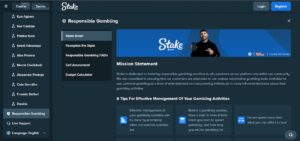
Stake’s responsible gambling tools are built to solve different problems, not the same one in six different ways. One tool controls how much money enters the account. Another controls how much is staked. Another limits net losses. Two tools restrict access for short or long periods. One tool helps a user review their own behaviour before choosing the next step. Understanding those differences is what makes the framework useful.
Deposit Limits On Stake
A Deposit Limit controls how much money can be added to the account over a set period. It works at the funding stage, not at the betting stage, which means it does not directly control how much is wagered after the money is already in the account. This makes it a practical tool for users whose main problem is repeatedly topping up beyond what they originally planned.
For local currency accounts, Stake’s help content currently describes this as a daily limit. Once the cap is reached, further deposits are blocked until the period resets. For cryptocurrency deposits, funds that exceed the limit are not treated the same way as ordinary rejected payments. They can be placed into a temporary holding balance and released gradually as the limit resets. Setting a new deposit cap or reducing one applies immediately, while increasing or removing it is subject to the standard 24 hour cooling off period.
Wager Limits On Stake
A Wager Limit controls the total amount a user can stake over a chosen period. The important distinction is that it measures betting volume, not deposits and not net losses. A user may deposit only once but still wager heavily across many bets during a session or over a week. In that scenario, a wager limit is often more relevant than a deposit limit.
Stake’s help content describes daily, weekly, and monthly wager limits. Unsettled bets count toward the total, and reducing the limit takes effect at once. Raising the limit does not. As with the other financial controls, a higher limit becomes active only after the cooling off period has passed. This makes Wager Limits especially useful when the issue is not funding the account, but losing track of betting volume once play begins.
Loss Limits On Stake
A Loss Limit works differently from both deposit and wager controls because it focuses on outcomes. It places a ceiling on how much a user can lose net of winnings over a selected period. This can be useful for users who are less concerned with how many bets they place and more concerned with the downside exposure of a losing run.
Stake offers daily, weekly, and monthly loss limits. Multiple limits can be active at the same time, and the smallest applicable one takes priority. As with other limit tools, lowering the threshold applies immediately, while increasing it requires the cooling off delay.
Break In Play On Stake
Break In Play is a temporary restriction designed for users who want distance from gambling without committing to a long exclusion. It sits between ordinary account access and a full self-exclusion. That makes it useful when a session has felt emotionally charged, when spending has started to slip, or when a person simply wants a clean reset.
Stake’s help content lists break periods ranging from 1 Day and 2 Days to 1 Week, 1 Month, 2 Months, and 3 Months. During that period, gambling activity is not allowed. When the break ends, access is restored automatically. The main value of Break In Play is that it creates a firm pause at the account level, which can be more effective than relying on willpower alone.
Self Exclusion On Stake
Self Exclusion is the strongest restriction tool in Stake’s framework. It is designed for situations where gambling no longer feels manageable, where limits are repeatedly being tested, or where the user wants a much stronger barrier than a short break can provide. Unlike a temporary pause, self-exclusion is meant for longer-term protection.
Stake’s help centre lists exclusion periods from 6 Months up to 10 Years, plus an Indefinite option. Indefinite exclusion carries a minimum duration of six months and does not end with automatic reactivation. A formal return to play review is required after that period. During any self-exclusion, account activity is not permitted. For users dealing with repeated loss of control, Self Exclusion is usually the clearest sign that the goal has shifted from moderation to real protection.
Self Assessment On Stake
Self Assessment is not a punishment and not a diagnosis. It is a short reflective tool that helps users look at their own behaviour with more structure than ordinary self-questioning usually provides. Stake presents this as a brief questionnaire that can help a person think about whether gambling is affecting responsibilities, emotions, or relationships.
Its main value is timing. Some users are not ready to apply a restriction immediately, but they do recognise that something feels different. In that stage, Self Assessment can be a useful first step.
Which Stake Responsible Gambling Tool Should You Use
The tools make more sense when they are matched to real situations. This section should stay practical. It is not about redefining the features, but about understanding which one best fits the problem a user is actually trying to solve.
If You Keep Depositing More Than Planned
If the recurring problem is adding more money to the account than intended, Deposit Limits are usually the best starting point. A deposit cap moves that boundary from intention to enforcement.
If Your Betting Volume Escalates During Sessions
Some users control deposits well but still find that a session grows far beyond what they expected once it begins. The number of bets rises, the pace quickens, and the total amount staked becomes much larger than planned. In that situation, Wager Limits are more precise than deposit controls because they target the volume of betting itself.
If You Are Most Concerned About Potential Losses
For some users, the main fear is not how often they bet, but how much money could be lost over a period. In that case, Loss Limits can provide more relevant protection than a wager cap.
If You Need A Short Reset
After an intense session, especially one shaped by frustration, near misses, or poor decisions, the immediate need may not be a six month restriction. It may simply be distance. Break In Play is well suited to that moment because it creates a clean pause without turning a short-term concern into a longer commitment than the user is ready to make.
If Gambling Is Affecting Daily Stability
When gambling begins to interfere with sleep, work, finances, or relationships on a repeated basis, a short pause may no longer be enough. In those situations, Self Exclusion is usually the safer option because it creates meaningful distance and removes the expectation of an automatic return after only a few days or weeks.
If You Are Unsure Whether There Is A Real Problem Yet
Not every concern begins at crisis level. Some users simply feel that their gambling behaviour has changed, but they are not yet sure what that change means. Self Assessment is valuable here because it allows for honest reflection before the next step is chosen. It can help the user decide whether basic limits are enough or whether stronger action should be considered.
Warning Signs Of Problem Gambling On Stake
A broad discussion of risk is useful, but warning signs are where the issue becomes personal. This is the point at which users can ask whether certain patterns have started to appear in their own behaviour. The goal is not to diagnose, but to recognise signals that should not be dismissed.
Spending More Time Or Money Than Intended
One of the earliest warning signs is simple but important. Sessions keep going longer than planned, or spending repeatedly exceeds the amount that was decided before play began. The amount itself may not always seem dramatic, but when a self-imposed boundary keeps slipping, that is already meaningful. A limit that exists only at the start of a session is not functioning as a real limit if it disappears once emotions take over.
Chasing Losses And Ignoring Stop Points
Chasing losses is one of the clearest red flags in gambling behaviour. It happens when continued betting is driven by the urge to recover what has already been lost rather than by enjoyment of the activity itself. The danger is not only the extra money at risk. It is the shift in mindset. Decisions become urgent, reactive, and tied to the hope that one more outcome will repair the earlier one.
Stress, Mood Changes, And Sleep Disruption
Problem gambling rarely stays inside the account. Stress around sessions, irritability after losses, trouble sleeping, or difficulty concentrating can all signal that gambling is occupying more mental space than it should.
Hiding Gambling From Other People
Secrecy is another important sign. This can mean avoiding conversations about gambling, minimising how much time or money has been spent, or feeling shame when the topic comes up. Hiding behaviour often reflects a private awareness that things are no longer fully under control. Even if the user is not ready to name the problem directly, concealment itself is a warning.
Struggling To Stick To Your Own Rules
A person may set a budget, a session limit, or a rule about not redepositing and then repeatedly fail to follow it. When that happens often, informal self-control is no longer doing the job. That is usually the point at which platform-enforced tools become more important. In many cases, the inability to follow one’s own rules is the clearest signal that stronger measures should be considered.
Stake Support, External Blocking Tools, And Protection Of Minors

Platform tools are not the whole picture. Some users need help from support staff. Some want device-level protection that goes beyond one account. Others need reassurance that age verification and child protection are being treated seriously. These areas matter because responsible gambling is not just about managing a session. It is also about access, support, and prevention.
Manual Support Requests And Review Options On Stake
Stake’s policy materials make clear that support channels can help if a user cannot begin the self-exclusion process alone. That matters because a person seeking protection may not always be in the best position to navigate menus or complete every step without help. The existence of a manual route through live chat or email reduces friction at exactly the point where delay can be harmful.
For users under Indefinite self-exclusion, the return to play review does not happen automatically after six months. A formal request is required, and Stake’s help documentation identifies support@stake.com as the contact point for that process.
External Blocking Tools And Safer Device Level Control
Account-level restrictions are valuable, but they do not always solve the full problem. A user may want protection across browsers, devices, or multiple gambling sites, especially if the issue is not limited to one operator. This is where external blocking tools become relevant. Stake’s responsible gambling resources specifically mention BetBlocker, Net Nanny, and Gamblock.
BetBlocker is designed to block access to gambling websites across devices. Net Nanny adds broader parental control functions and can be especially useful on shared household devices. Gamblock also aims to restrict access to gambling platforms across devices. Gamban can be mentioned as another well-known external blocker, but it should be identified as an additional market option rather than a tool listed by Stake’s own materials.
Age Verification, KYC, And Protection Of Minors
Responsible gambling also includes restricting access before gambling begins. Stake states that its services are intended for adults aged 18 and over, and its verification framework plays an important role in enforcing that rule. The KYC process is not only about compliance. It also supports safer access by checking whether a user is eligible to use the platform at all.
That framework can involve identity and age checks, as well as information such as name, address, country, postal code, and date of birth. Stake’s policy materials also recommend practical safeguards when minors may have access to a shared device. That includes not leaving gambling accounts logged in, keeping passwords private, and using filtering software where appropriate. This section strengthens the trust theme of the article because it shows that Protection Of Minors is part of the wider safety structure, not a side note.
Final Thoughts On How To Gamble Responsibly On Stake
Responsible gambling on Stake works best when it is treated as an active system rather than a passive warning. Deposit Limits, Wager Limits, and Loss Limits control different parts of spending behaviour. Break In Play and Self Exclusion create stronger account-level barriers when ordinary limits are not enough. Self Assessment, manual support pathways, external blockers, and age verification measures add further layers of protection.
The right response depends on the problem. Some users need a spending cap. Some need a short pause. Some need a long exclusion and outside support. If gambling is no longer functioning as entertainment, the safest move is to use the tools early and choose the level of protection that fits the moment.
Latest News